ATLAS PROJECT

Image Transformation Engine

A visual experimentation system for turning source sketches, photographs, diagrams, and conceptual motifs into coherent new imagery while preserving the structural ideas that matter.

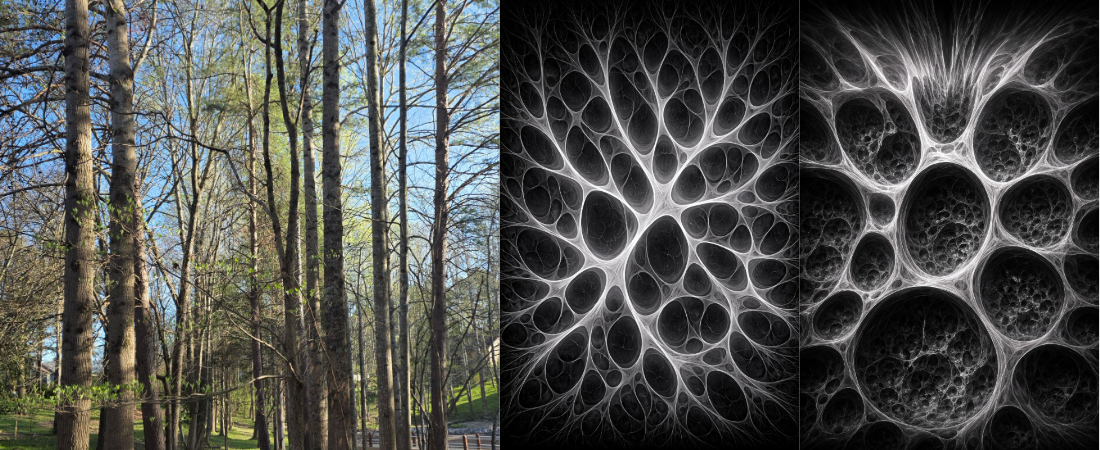
Cluster of trees transformed into a recursive void-space fractal structure
01

Void-First Fractal Extraction — Cluster of Trees

The source tree cluster is treated primarily as a map of negative space, not as a collection of trunks and leaves. A void-mask pass identifies the irregular openings between branches, then recursively propagates those openings into nested cavities. Local distance-to-edge values become branch-like membranes, producing an organic fractional structure that preserves the rhythm of the original forest while discarding literal tree identity.

$VOID.FIRST$FRACTAL.DIM≈2.3–2.7$EDGE.RECURSE$SOURCE.IDENTITY=LOW
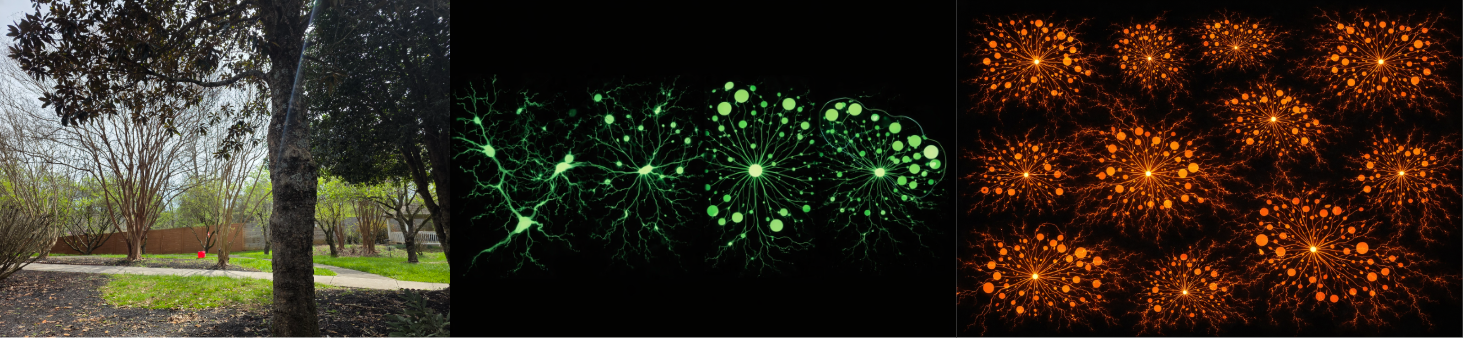
Tree branching geometry rearranged into a node and edge network
02

Branch-to-Node Network — Tree Topology Rebuild

Here the tree is reduced to its branching graph. Junctions, endpoints, and high-curvature areas become weighted nodes; limbs become edges. The graph can then be re-centered, stretched, repeated, or radially reorganized without losing the source topology. Node size is driven by local connectivity and branch density, while secondary filaments preserve the feel of natural growth.

$GRAPH.EXTRACT$NODE.WEIGHT=DEGREE$RECENTER=HEAVY_NODES$BRANCH.REPEAT
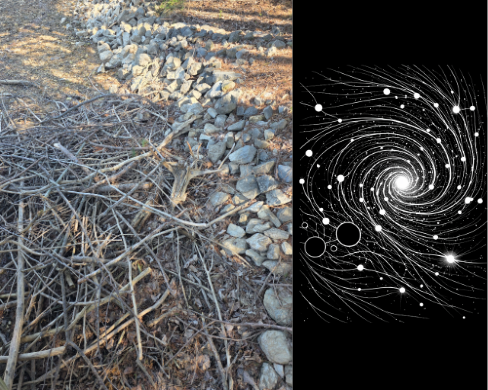
Pile of twigs transformed into a gravitational spiral of filaments and nodes
03

Directional Fiber Field + Gravity Well — Pile of Twigs

The twig pile supplies thousands of short directional line segments. Those segments are sampled as a fiber field, aligned into larger flow paths, and then warped around a synthetic center of gravity. The result converts random physical clutter into coherent orbital motion. Bright nodes mark intersection density or emphasized mass points, while the underlying strands retain the angular character of the source.

$FIBER.FIELD$GRAVITY.WELL=CENTER$FLOW.SPIRAL$INTERSECTION.NODES
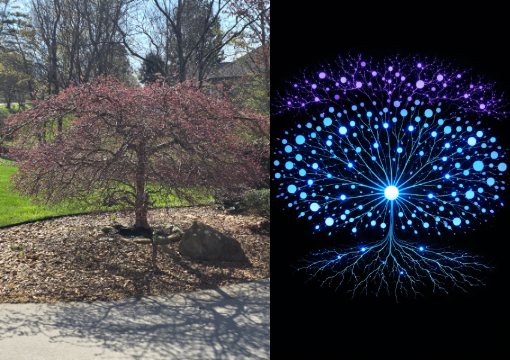
Japanese ornamental bush transformed into a radial blue and violet branching network
04

Canopy Density Mapping — Japanese Bush

The ornamental bush is interpreted as a layered density profile: trunk, radial branch spread, outer canopy, and peripheral fine structure. Branch vectors are normalized around a central anchor and converted to a luminous node network. Larger terminal nodes represent dominant visual masses; smaller points populate the outer canopy. A controlled blue-to-violet palette separates structural depth while preserving the source's low, umbrella-like silhouette.

$CANOPY.MAP$RADIAL.NORMALIZE$NODE.SIZE=DENSITY$PALETTE=BLUE_VIOLET
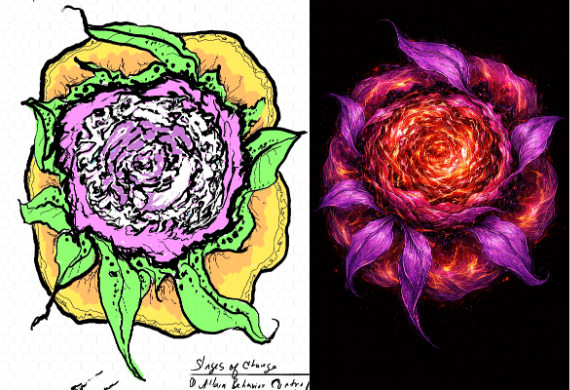
Hand-drawn flower artwork transformed into a glowing layered energy bloom
05

Semantic Geometry Preservation — reMarkable Artwork

The sketch contributes the semantic geometry of the piece: a dense center, concentric petal layers, irregular outer leaves, and rotational asymmetry. Instead of tracing the drawing literally, those relationships become constraints. Petal contours are rebuilt as flowing surfaces, the core is amplified into an energy well, and color is assigned by structural role—warm orange/red toward the center and violet across the surrounding petals.

$SEMANTIC.GEOMETRY$CORE.AMPLIFY$PETAL.REBUILD$PALETTE=EMBER_VIOLET
A

How the Engine Thinks

The working recipes are not conventional one-click filters. They are a repeatable sequence of structural extraction, topology analysis, weighted recomposition, recursive detail generation, and palette assignment. Different sources contribute different “genes”: voids, edges, nodes, flow, density, or semantic form.

B

Reusable Macro Layer

Atlas macros capture successful visual decisions as named controls—void-first extraction, fractal dimension, gravity wells, heavy-node recentering, node weighting, palette families, and source-identity retention. The macro layer makes a transformation recipe portable across unrelated images while still allowing the source structure to drive the result.

C

Human-Directed Output

The process remains intentionally art-directed. A human decides which structural property matters, which features should survive abstraction, and how aggressively the result should diverge from the source. The engine provides continuity and repeatability without forcing every image into the same visual style.