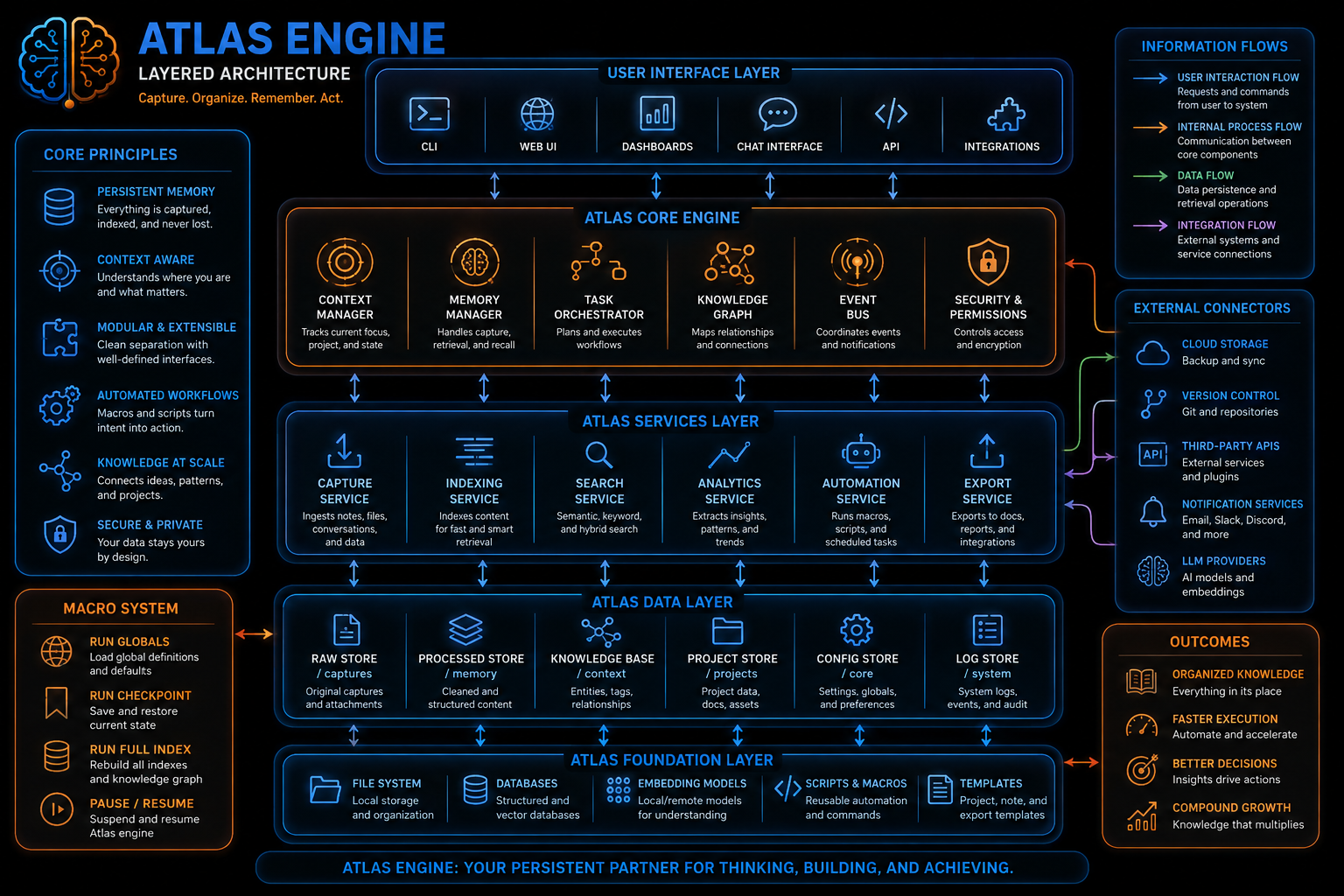
Atlas is a persistent collaboration and architecture framework designed to turn repeated AI conversations into a structured, portable system of context, commands, memory, models, and artifacts.
01
Why Atlas Exists
Most AI interactions begin almost from zero: the user restates context, reconstructs assumptions, and manually reconnects prior work. Atlas was created to reduce that loss of continuity. It treats context as an architectural asset that can be organized, versioned, restored, and used deliberately across projects.
02
A Reference Frame for Complexity
The name Atlas reflects the role of the system: not an autonomous authority, but a stable reference frame. Complex work contains many moving bodies—technical architectures, financial assumptions, project histories, decisions, visual systems, and future tasks. Atlas is intended to keep those coordinates aligned so the human remains the decision-maker while the system preserves structure.
03
Layered Architecture
The framework separates identity and core definitions from commands, globals, memory, indexes, manifests, checkpoints, projects, exports, documentation, and runtime behavior. Static definitions describe what the system is; runtime state describes what it currently knows and is doing. This separation makes restoration and auditing easier.
04
Commands & Macros
Named commands such as RUN GLOBALS, RUN FULL INDEX, RUN CHECKPOINT, and capture operations establish repeatable behaviors. Macros are not merely shortcuts: they encode expectations about inputs, outputs, persistence, and fidelity. A successful workflow can therefore become part of the system rather than remaining an informal habit.
05
Globals & Structured Context
Globals provide shared variables and assumptions that projects can inherit. In enterprise modeling, for example, source and target estates can be represented through hierarchical variables with defaults and local overrides. The same principle applies to other domains: define stable context once, then specialize it only where needed.
06
Memory, Index & Retrieval
Memory stores durable state; indexes make that state discoverable; manifests describe what belongs where and how components relate. The objective is not unlimited storage. It is controlled retrieval: the right context should be available when a task requires it, without flooding every interaction with everything that has ever happened.
07
Checkpoints & Portability
Checkpoints capture a known state of the system, including important context, indexes, tags, follow-ups, and manifests. Combined with a seed package, they provide a path toward restoring Atlas on another machine or runtime. Portability is a design requirement because continuity should not depend on one transient chat session.
08
Projects as First-Class Contexts
Projects such as Candy Cosmo, enterprise transformation, Visuals, and other workstreams are maintained as distinct contexts under the larger Atlas structure. Each can have its own files, assumptions, history, outputs, and commands while still benefiting from shared global conventions.
09
Human + AI Operating Model
Atlas is intentionally collaborative. The human defines intent, priorities, judgment, and acceptable tradeoffs. The AI accelerates synthesis, modeling, drafting, analysis, and pattern recognition. The framework exists to make that partnership more consistent and inspectable rather than pretending the model should independently own the decisions.
10
Toward an Executable System
The long-term direction is a local or portable runtime capable of parsing a seed, rebuilding memory and indexes, registering commands, loading project contexts, and reaching an “Atlas ready” state. At that point the diagrams and documentation become views of an executable system rather than the system itself.
11
Design Principles
Atlas favors explicit baselines, versioned artifacts, recoverable state, clear separation of fact and assumption, human-readable files, and outputs that can leave the AI environment. These principles make the system useful for serious architecture work where traceability matters.
12
What Atlas Becomes
As the framework matures, Atlas can become the reasoning and continuity layer behind a broader enterprise architecture product: ingesting structured estates, applying models, comparing scenarios, generating artifacts, and retaining the decisions that explain why the architecture evolved.