ATLAS PROJECT
Healthcare Tracker
A flexible, local-first scoring and history system for organizing daily behaviors, measuring progress, and revealing patterns over time.
01
Dynamic Daily Scoring, Flexible Categories & Long-Term History
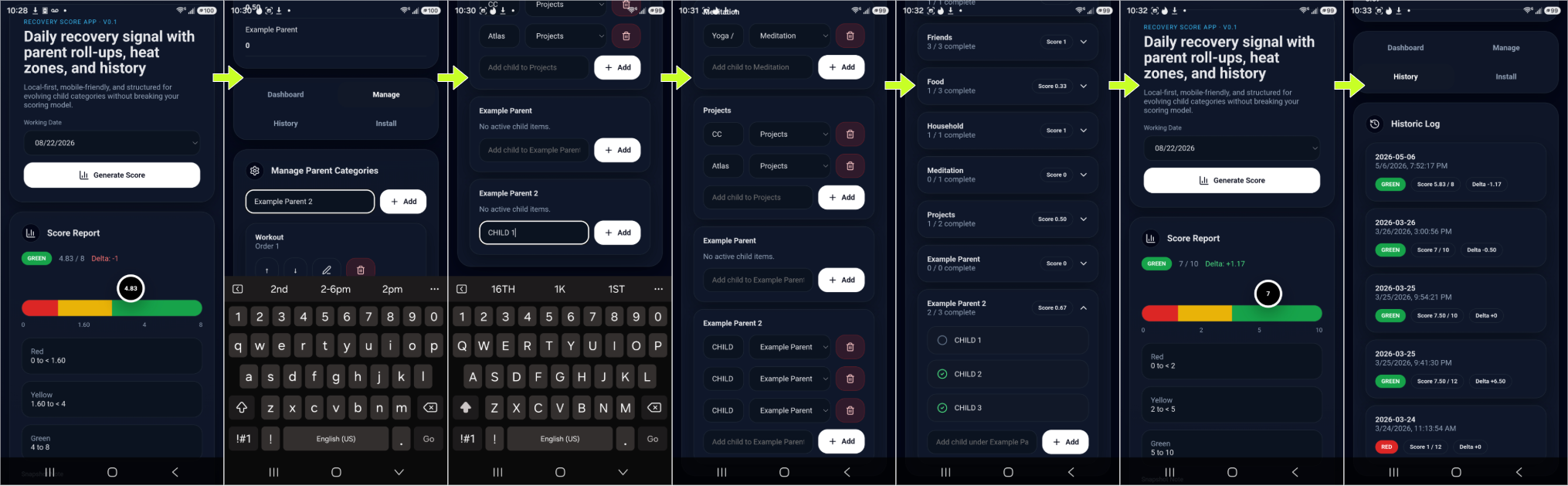
The Healthcare Tracker turns daily routines into a configurable scoring model rather than forcing every user into a fixed checklist. Parent categories can be created for broad areas of focus, with child items added underneath them to represent the specific actions that matter. As items are completed, the daily score updates immediately, making progress visible while the day is still unfolding.
Parent + Child Structure
Users can define high-level categories and add or reorganize child behaviors beneath them. This creates a hierarchy that can evolve as routines, priorities, or goals change without rebuilding the application.
Immediate Score Feedback
The score responds dynamically as child items are completed. The visual red, yellow, and green ranges make the current state easy to interpret at a glance and help turn many small daily actions into one understandable signal.
Historical Pattern Review
Completed scores are retained in a historical log so progress can be compared across days, weeks, months, and years. Strong periods become visible, but difficult days remain equally useful because they can expose recurring patterns, timing effects, or combinations of behaviors worth examining.
01
Design Goal
The tracker is intentionally direct. Instead of spreading daily information across notes, messages, and memory, it creates one chronological record with consistent categories and timestamps. The focus is usability during normal life rather than creating a complicated clinical system.
02
Tracked Information
The baseline model includes medications, food, water, insulin, timestamps, and placeholders for additional observations. Entries can be reviewed as a sequence, making it easier to understand what happened and when without reconstructing the day afterward.
03
Human-Centered Workflow
The system was designed for shared use and easy review. Simple inputs and clear labels matter more than sophisticated analytics at the first stage. The architecture can later support reminders, summaries, trend views, or exports without changing the basic capture model.
04
Data Principles
Health-related data should remain private, minimal, and understandable. A future implementation should make ownership, storage, access, retention, and export behavior explicit before adding cloud synchronization or third-party integrations.
05
Future Direction
The next evolution could add configurable event types, daily summaries, printable reports, and optional analytics while preserving the original principle: fast, reliable capture first; interpretation second.